Selling land is different from selling a house. A house usually sells a lifestyle: bedrooms, kitchen, neighborhood, school district, photos, and move-in appeal. Land sells possibility. That means buyers will ask harder questions before they make a serious offer.
Before you list your land, you need to know what you actually have, what someone can legally do with it, what problems may scare buyers away, and what documents can make the sale easier.
Many landowners make the same mistake: they list the parcel first and start answering questions later. That often leads to weak offers, long delays, price cuts, or buyers walking away during due diligence.
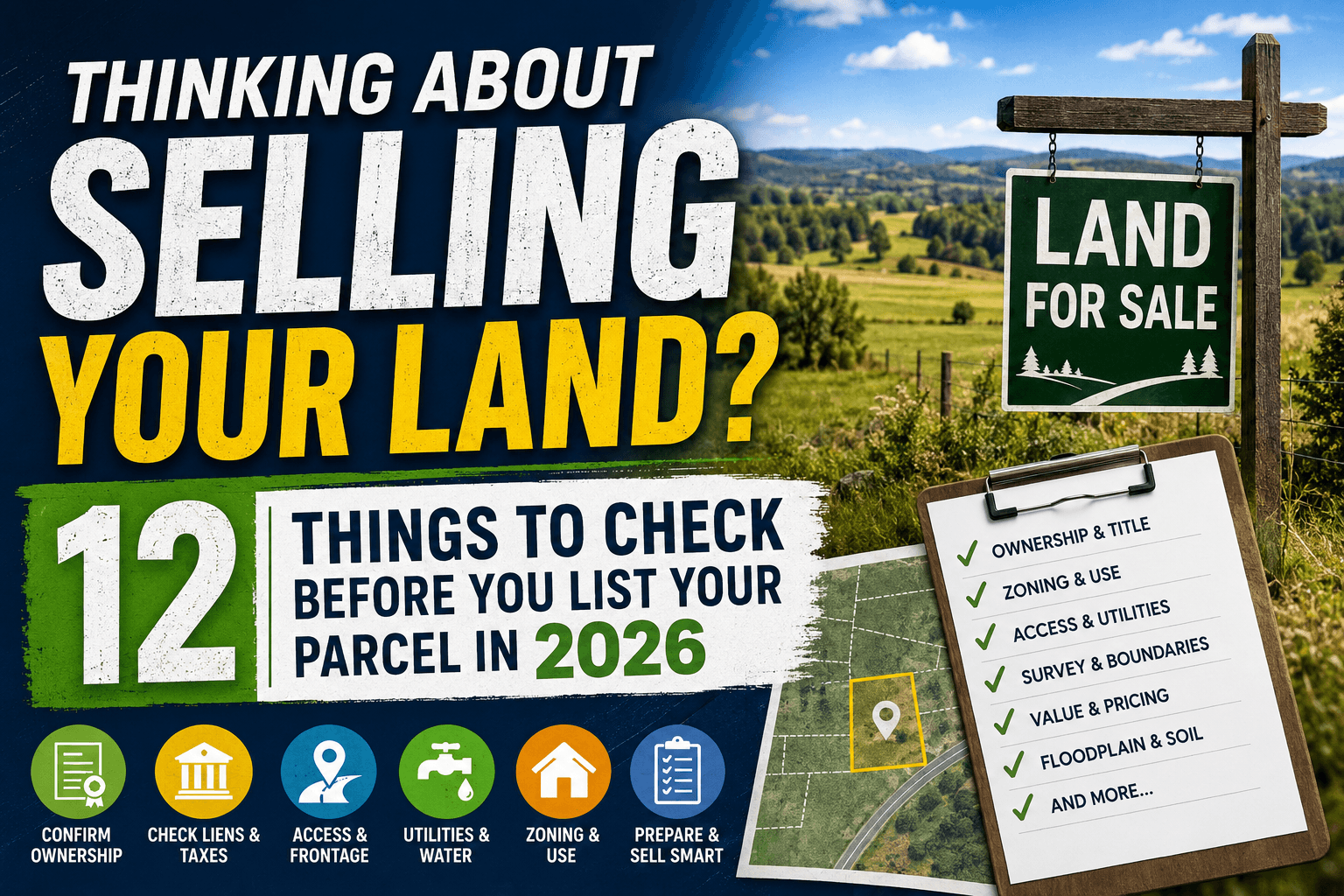
This guide walks through the 12 things every land seller should check before putting a parcel on the market.
Before thinking about price, photos, or buyers, start with ownership.
Ask yourself:
Do you personally own the land?
Is it owned by multiple family members?
Is it part of an estate?
Is it owned by a trust, LLC, partnership, or deceased relative?
Is there a mortgage, lien, unpaid tax balance, or judgment attached to it?
Land sellers often underestimate this step. They assume that because the property has been “in the family for years,” selling it will be simple. But older parcels often come with older paperwork problems.
You may need to confirm:
If more than one person owns the parcel, every required owner usually needs to sign closing documents. If one sibling, spouse, heir, or business partner does not agree, the sale can stall.
A serious buyer may be patient with a title issue if the land is attractive, but they will not wait forever. Fix ownership questions before you list.
Landowners sometimes hold vacant land for years without doing much with it. During that time, small issues can pile up.
Common problems include:
A buyer may still purchase land with some of these issues, but the problems must usually be disclosed and resolved before closing.
Back taxes are especially common with inherited or unused parcels. Some sellers are surprised to learn that a small unpaid balance has become a bigger issue after penalties, interest, or county action.
Before listing, contact the county tax office or check the county property portal. Confirm the balance due and whether there are any tax sale risks.
This is not the exciting part of selling land, but it protects you from embarrassment later. You do not want to accept an offer, start closing, and then discover that the title company cannot close until an old problem is fixed.
One of the biggest pricing mistakes land sellers make is using the county assessed value as the asking price.
The assessed value is mainly used for property tax purposes. It is not always the same as what a buyer will pay. Some counties update assessments regularly. Others lag behind the real market. Some assessed values are much lower than market value, while others may be higher than what buyers are willing to pay.
The real market value of land depends on things like:
Actual land sellers often get frustrated because they believe, “The county says it is worth this much,” while buyers respond based on what the land can actually be used for. In real seller discussions, this comes up often: assessed value may be a reference point, but buyers usually care more about comparable sales, access, utilities, zoning, and realistic use potential.
A parcel with legal road frontage, utilities, clear zoning, and a passed perc test may be worth much more than a similar-sized parcel with no access, no septic option, and unclear use.
Do not price land only by acreage. Price it by usefulness.
Many landowners do not know exactly where their land begins and ends.
That becomes a problem when buyers ask:
Where are the corners?
Is there a recent survey?
Is the fence on the boundary?
Does the driveway cross someone else’s land?
Is the neighbor using part of the parcel?
Are there encroachments?
Does the county GIS map match the deed?
County GIS maps are helpful, but they are not a replacement for a survey. GIS lines can be approximate. A buyer who plans to build, fence, farm, subdivide, or finance the purchase may want stronger boundary confirmation.
If you already have a survey or plat, include it in your seller packet. If the survey is old, review whether anything has changed since it was completed.
You may not always need to order a brand-new survey before listing, especially for lower-value land. But you should at least know whether one exists and what it shows.
Boundary uncertainty creates doubt. Doubt creates lower offers.
777 Brickell Ave, Suite 500-99620, Miami, FL 33131
Access is one of the most important land-selling issues.
A parcel may look accessible on a map, but that does not mean it has legal access.
There is a big difference between:
Buyers care because land without legal access can be hard to use, hard to finance, hard to develop, and hard to resell.
Before listing, check:
If access is unclear, be honest. Do not advertise “road access” just because there is a visible trail. Buyers will investigate it, and if your listing exaggerates access, the deal can fall apart.
If your land is landlocked, it may still have value, especially to a neighbor, investor, hunter, timber buyer, or conservation buyer. But the price and buyer pool will be different.
Land buyers do not just buy dirt. They buy the right to do something with it.
That “something” might be:
Zoning and land-use rules decide what is allowed.
Before listing, contact the county or city planning department and ask basic questions:
What is the zoning classification?
Is residential building allowed?
Are mobile homes allowed?
Can the parcel be subdivided?
What are the minimum lot size requirements?
What are the setbacks?
Are there restrictions on camping, RVs, or temporary structures?
Is there an HOA, deed restriction, or conservation restriction?
Are there special overlays, environmental restrictions, or agricultural rules?
A common seller mistake is saying “great homesite” without confirming whether a home can actually be built.
If the land is buildable, say why. If it is not buildable, market it for the correct use: recreation, neighboring expansion, timber, hunting, grazing, parking, storage, conservation, or long-term hold.
The clearer the use case, the easier it is for buyers to understand the value.
For land buyers, utilities can make or break the deal.
A parcel with available power, water, and sewer is usually easier to sell than a parcel where the buyer must figure everything out from scratch.
Before listing, verify:
For rural land, septic is often one of the biggest questions. If the land does not have sewer access, the buyer may need a perc test to determine whether the soil can support a septic system.
The EPA advises buyers to understand septic systems before purchase and highlights inspection, system condition, and maintenance as important due diligence points. For land sellers, this means septic information can directly affect buyer confidence. (EPA SepticSmart Home Buyer’s Guide)
A failed perc test does not always make land worthless, but it can reduce the buyer pool. Some parcels may need an alternative septic system, which can cost more. Others may not be suitable for a home at all.
If your parcel already has a passed perc test, old septic approval, well records, or utility availability letters, make those documents easy to access.
Land sellers sometimes think, “The buyer can figure that out.” Yes, they can. But if you figure it out first, you may attract better buyers and stronger offers.
Some land looks good in photos but has hidden limitations.
Before selling, check whether the parcel has:
Buyers will often investigate these during due diligence. If they discover a major problem after making an offer, they may renegotiate or cancel.
You do not need to become an engineer, but you should understand obvious risk factors. For example, if half the parcel is in a flood zone, do not market the full acreage as if all of it is equally usable.
FEMA explains that flood maps help communities identify areas with higher flood risk, and landowners can use official flood map tools to understand whether a property may be affected. (FEMA Flood Maps)
The most important question is not “How many acres do I own?” It is:
How many acres are usable for the buyer’s intended purpose?
That is what serious buyers care about.
Not every land buyer is the same.
A small residential lot may appeal to a neighbor, builder, or local homeowner.
A rural 40-acre parcel may appeal to hunters, farmers, recreational buyers, timber buyers, or long-term investors.
A parcel near development may appeal to builders or developers.
A landlocked lot may appeal mostly to adjoining owners.
A failed-perc parcel may appeal to recreation buyers instead of homebuilders.
Before you list, ask:
Who would want this land the most?
Possible buyer groups include:
Many real land sellers find that neighbors are the best first contact. A neighbor may want the land for privacy, expansion, access, farming, family use, or to prevent someone else from buying it.
Before paying for marketing, consider sending a simple letter to adjoining landowners. Do not pressure them. Just let them know you are considering selling and ask if they would like to discuss it.
Sometimes the best buyer is already next door.
777 Brickell Ave, Suite 500-99620, Miami, FL 33131
There is no single best way to sell land. The right path depends on your parcel, timeline, location, price, and comfort level.
A good land agent understands zoning, access, utilities, maps, local buyer demand, land photography, and land listing platforms.
This can be a strong option if your parcel has meaningful value, development potential, rural acreage, or a specialized buyer pool.
The risk is hiring a general residential agent who mostly sells houses and treats your land like an empty house listing. Land needs different marketing.
Selling by owner can work if you understand the property, can answer buyer questions, and use a title company or attorney for closing.
This may save commission, but it also puts more responsibility on you.
This can be one of the simplest paths, especially for small lots, landlocked parcels, access strips, odd-shaped parcels, or land that improves a neighbor’s property.
You may not always get the highest possible price, but you may get a cleaner and faster sale.
Auctions can work well for unique land, high-demand land, farmland, recreational land, or estate situations. But auction results depend heavily on promotion, buyer interest, and auction terms.
Land-buying companies often offer speed and convenience. The tradeoff is that they usually expect a discount.
That does not automatically make them bad. Some sellers value speed more than top-dollar pricing. But you should compare the offer against real market value before accepting.
If someone offers to buy quickly, ask yourself:
Am I choosing convenience knowingly, or am I being rushed into a low offer?
That difference matters.
A strong land listing does not just say “10 acres for sale.”
It gives buyers enough information to understand the opportunity.
Prepare a simple seller packet with:
This helps serious buyers move faster. It also reduces repetitive questions.
A buyer who has to dig for every answer may assume there are problems. A buyer who receives a clear packet may feel more confident making an offer.
Confidence helps land sell.
Even if the buyer seems friendly, use a proper closing process.
For most land sales, that means working with a reputable title company, escrow company, real estate attorney, or closing professional depending on your state.
A safe closing process helps confirm:
Do not casually sign over a deed in exchange for a personal promise, partial payment, handshake, or confusing agreement.
Wire fraud is another reason to use a careful closing process. First American warns that last-minute wiring instruction changes should be verified by calling a trusted number, not a number provided in a suspicious email. (Protect Your Real Estate Transaction from Wire Fraud)
If you offer seller financing, get professional help. Seller financing can attract more buyers, but the documents must be clear. You need to understand payment terms, default rights, interest, taxes, insurance, recording, and what happens if the buyer stops paying.
Land is valuable. Treat the closing like it matters.
Before you list your land, confirm these items:
Selling land is easier when you stop thinking like a casual owner and start thinking like a careful buyer.
A buyer wants to know:
Can I access it?
Can I use it?
Can I build on it?
Is the price fair?
Are there hidden problems?
Can we close safely?
If your listing answers those questions clearly, your land has a much better chance of attracting serious buyers instead of lowball offers and wasted time.